Driving measurable business impact with Data & AI.
Embracing leading-edge technology is the key to uncovering limitless possibilities in business.
I’m a builder, executive leader, and technologist at heart—deeply passionate about delighting customers through cutting-edge innovation. My work spans AI strategy, data analytics, and experience design, all underpinned by a vision to elevate people and processes. Over the years, I’ve partnered with companies of all sizes to discover and achieve their loftiest aspirations by aligning technology with real-world business needs.
Who am I
I’m David Berglund, founder of Itasca Labs. I guide organizations in harnessing Data & AI strategies to achieve transformative growth.
What I Do
Key Pillars
People-Centric: My mission is built around enabling leaders and teams.
Innovation-Focused: I believe creative problem-solving is the catalyst for sustainable growth.
Outcome-Driven: Every project is measured by tangible value—whether that’s market share, efficiency gains, or a stronger brand.
AI INNOVATION
AI INNOVATION
Unlocking limitless potential.
Yesterday's impossible is tomorrow’s possibility. AI is more than just technology—it's a bridge to the future of human progress. It's our opportunity to maximize human potential as we augment human intellect, pushing us toward an abundant future.
Thought Leadership
Crafting an effective AI strategy requires focusing on people-oriented aspects: Alignment, Inspiration, Influence. Alignment synchronizes AI with organizational goals, fostering ethical standards. Inspiration encourages innovation with a compelling vision, celebrating successes. Influence drives action through leadership, overcoming resistance. True AI potential is unlocked by integrating these aspects, ensuring technical proficiency and broad support.
"Mastering the Art of Strategic AI Transformation in Business" underscores the importance of integrating artificial intelligence (AI) and machine learning (ML) into business strategies to stay competitive. It emphasizes that AI is crucial for organizational growth and transformation, highlighting the need for strategic alignment, leadership commitment, and an AI-ready culture. The article advocates for a balanced approach to AI adoption, addressing challenges like integration complexities and the necessity of fostering a culture of innovation. It stresses the importance of avoiding common mistakes such as lacking a clear strategy or underestimating cultural shifts, ultimately arguing that successful AI implementation requires strategic planning and collaboration to unlock business innovation.
When I studied abroad at Loyola University Chicago John Felice Rome Center, one of the most memorable events was learning about the Florence Cathedral's fascinating history. Facing a (seemingly) impossible engineering task, Brunalleschi's innovative approach now serves as a masterclass for today's leaders seeking transformation. Brunelleschi's blend of historical insight, resilience in adversity, and iterative innovation offers a blueprint for modern innovators. This story isn't just about building a structure; it's about constructing a mindset for transformative leadership.
In an era where Artificial Intelligence (AI) is reshaping industries, understanding and enhancing AI maturity within an organization has become a critical competitive advantage. This white paper outlines a comprehensive AI Maturity Model designed to assist companies in assessing and advancing their AI capabilities. The model encompasses five core dimensions: Business Impact, Responsible AI, Data Mastery, Engineering Excellence, and Organizational Readiness.
What could Warren Buffet’s Investment philosophy teach us about innovating with AI? Surely, as the 5th richest person in the world and CEO of Berkshire Hathaway, Buffet knows a thing or two about building durable strategies for business growth. More importantly, Buffet has succeeded across decades and technology booms/busts.
How does he do it? Here are 7 key elements of Buffett's investment philosophy that can be applied to innovating with AI.
It was so exciting to participate in the second 'AI for Good' event, a 48-hour hackathon bringing together UNF student teams and partners First Tee, Amazon Web Services (AWS), and NLP Logix to build solutions that drive social and environmental benefits.
Special thanks to all the great partners who joined us over the weekend.
UNF College of Computing, Engineering & Construction (CCEC), PGA TOUR, and CapTech.
The teams used real-world data from First Tee to solve these high-impact problems:
#1: Engaging Youth: Enhancing Participant Retention in Ages 12 and Older
#2: Equitable Expansion: Reaching Underserved and Underrepresented Communities
Selling AI to Humans — Lessons from Daniel Pink.
Daniel Pink's book ‘To Sell is Human’ reframes selling as the art of moving others, focusing on empathy, resilience, and the clarity to solve problems. If you’ve tried selling AI solutions (or have been sold them), you’re aware there are a whole new set of questions and concerns that come up compared to non-AI products.
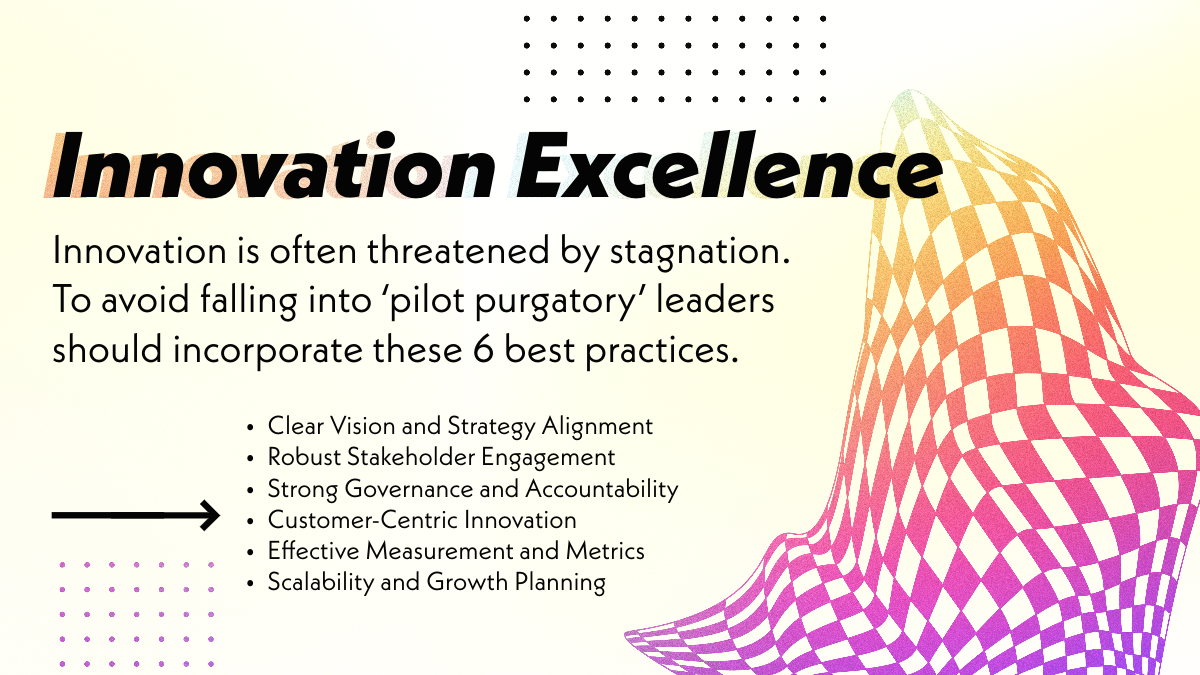
Innovation agendas often start with a bang but end up stagnating. To avoid falling into "pilot purgatory," incorporate these six innovation best practices.
Many companies have launched a flurry of AI projects, but don't have a clear strategy for how the work aligns with the company's mission and objectives.
Incorporating GenAI into an organization’s overall strategy ensures it becomes a powerful tool for innovation and competitive advantage. By aligning AI initiatives with broader business goals, companies can harness the full potential of AI to drive innovation, enhance competitiveness, and achieve sustainable growth coherently and strategically.
This 5-Factor strategic framework provides a structured approach to developing and executing a Generative AI strategy, ensuring that key aspects such as sequencing, growth avenues, competitive differentiation, market focus, and financial viability are thoroughly considered and aligned with business objectives.
Effective risk management and governance in AI/ML are crucial for companies aiming for sustainable value creation. Early integration of these practices ensures alignment with regulatory requirements and ethical standards, promoting transparency and accountability. Focused strategies in these areas enable businesses to navigate uncertainties, enhance decision-making, and foster a resilient environment conducive to innovation and long-term success.
The Perfect Pot Paradox highlights the need for iteration and experimentation vs. seeking perfection when innovating. Clinging to the need for a perfect solution can cripple innovation. Initial flaws in a prototype or model shouldn't be discouraging. Instead, view them as stepping stones towards refinement. In technology, we often hear of the ‘minimal viable product’ (MVP) approach. This essentially embodies the second group's methodology: release, learn from real-world feedback, and iterate.
Harness the power of generative AI like ChatGPT for your business by focusing on feasibility, viability, and desirability. Dive into data-rich environments like emails and documents for practical AI integration, pinpointing areas for efficiency to boost profitability. Prioritize human-centric solutions, targeting tedious internal tasks and enhancing customer interactions with personalized content. Ensure success by assembling a diverse team for innovative, aligned AI implementation.